

 https://doi.org/10.59875/1009INEXT1143
Figures (Includes Tables)

Abstract
Introduction
Adolescence is a period of rapid physical growth and cognitive development with consequences for health in later life. In this period, anaemia can reduce physical capacity, impair school performance and general well-being. Adolescent girls have a higher risk due to the demands of rapid growth and menstrual blood loss. Poor dietary intake and micronutrient deficiency can aggravate the problem. Anaemia during adolescence can affect future reproductive health if nutritional deficiencies persist in pregnancy.
Large-scale surveys and regional studies show that the distribution of anaemia is far from uniform and heavily impacted by social and structural factors, despite the fact that anaemia is predominantly dietary. The risk of anaemia and the availability of preventive and therapeutic interventions can be influenced by a number of factors, including household socioeconomic level, gender norms, parental education, caste and tribal status, and living environment.1, 2 Anaemia is distributed unevenly among different population groups as a result of the interaction of these factors.
Geographical, social, and cultural variety all contribute to these disparities in India. Adolescent females in rural villages or remote tribal areas may have significantly different circumstances than those in urban informal settlements.
Poor sanitation, food insecurity, and an increase in the availability of inexpensive, high-energy meals are all linked to urban poverty. Rural girls' nutritional status is influenced by healthcare infrastructure, maternal education, and household income (1,2). Geographical isolation and a lack of access to healthcare services have an impact on tribal populations. Geographical residence should therefore be considered in the context of the larger social and structural circumstances that adolescents live in rather than in isolation.
There are extensive government nutrition and supplements programs in place. However, its efficacy among vulnerable groups is limited by issues with program implementation and adherence. Designing interventions that are fair in reach thus requires an understanding of the disparity in the distribution of anaemia. Few studies have looked at the factors that contribute to anaemia in adolescents in India, but little is known about how these factors interact in urban, rural, and tribal contexts (1,2).
In this review, we attempt to synthesize the evidence on social inequalities in anaemia among adolescent girls in the Indian context in order uncover shared pathways and study implications for policy and research.
Materials And Methods
A narrative review was undertaken to synthesise the available evidence on social inequalities in anaemia among adolescent females in India. The review focused on the social, socioeconomic, nutritional, geographic and health-system factors contributing to inequalities in the burden of anaemia, with emphasis on urban, rural and tribal settings.
A literature search was conducted between June 2025 and December 2025 using the following electronic databases: PubMed/MEDLINE, Scopus, Embase, Directory of Open Access Journals (DOAJ), and Google Scholar. The search was conducted for studies published between 2020 and 2025.
The search strategy used combinations of keywords related to anaemia, adolescence, social inequality and associated determinants. The search terms included “anaemia”, “anemia”, “adolescent females”, “adolescent girls”, “social inequality”, “social determinants”, “socioeconomic factors”, “poverty”, “dietary diversity”, “caste”, “tribal”, “rural”, “urban”, and related terms. Keywords and Boolean operators were used in combination for various databases.
Only articles published in English were considered. The search mainly focused on Indian studies that addressed social inequalities or determinants of anaemia among adolescent females in urban, rural or tribal settings. Studies were considered eligible if they studied anaemia among adolescent females and reported findings related to social, socioeconomic, demographic, nutritional, geographic, environmental or health-system related factors.
Quantitative observational studies, qualitative studies, secondary analyses of population-based datasets, and relevant programme evaluations were considered. Exclusion criteria included studies focusing on populations outside the adolescent age group, studies that did not report anaemia-related outcomes, and studies unrelated to social determinants.
Title and abstract of the relevant articles were screened. This was followed by full-text assessment for eligibility. Data on study setting, population, anaemia burden, and relevant socioeconomic, nutritional, gender-related, geographic and health-system factors were extracted. Studies were grouped by geographical setting (urban, rural and tribal) and study design. As the studies were heterogenous, findings were synthesised narratively to identify common and setting-specific pathways linking social inequalities with anaemia among adolescent females.
Results
Anaemia has a high prevalence among adolescent girls in India although there is variation across various population groups and geographical areas. Available community based studies report a prevalence ranging from moderate to very high. A national-level analysis of household survey data documented substantial burden of anaemia and identified socioeconomic gradients across regions and caste/tribe groups (1). Community based studies have reported variation in prevalence across rural settings. A study conducted in 400 adolescent school going girls reported a prevalence of 43% with higher prevalence in younger groups (10-14 years) and low socioeconomic status (2). Facility-based data from a tertiary hospital in Chennai documented prevalence estimates near 58%, highlighting that clinical settings continue to encounter a substantial number of anaemic adolescents, often with nutritional deficits (3).
Studies from rural districts in Gujarat and other states reported prevalence of iron-deficiency anaemia exceeding 60%, with strong association with low family income, maternal illiteracy, and poor dietary diversity (1). Large-scale analyses from Uttar Pradesh and Bihar also demonstrated higher anaemia prevalence among adolescent girls compared to boys, and identified education, stunting, and rural residence as important predictors (2). Urban residence does not confer protection with studies from urban informal settlements reporting persistent anaemia due to social and environmental factors like poor sanitation, food insecurity, and gender-based neglect of adolescent girls (4,3).
In India, geographic and logistic barriers have been linked to reduced access to anaemia preventive services among adolescent girls. A study done in South India found that the inadequate availability of transport disrupted the iron and folic acid (IFA) supplementation supply chain in schools, directly impeding adolescent access.
According to UNICEF, nearly two in five adolescent girls in India remain anaemic, with some improvement in the burden of anaemia seen in the periods 2015–16 and 2019-21 (5,6). Iron deficiency accounts for more than half of adolescent anaemia cases, though folate, vitamin B12, and infections also contribute (7). The WHO fact sheet emphasizes that anaemia is not only an Indian problem but a global public health challenge that affects 30% of women of reproductive age worldwide, with adolescents being particularly vulnerable (8).
Overall, the available evidence suggests that anaemia has a high prevalence in adolescent girls in India and is not uniformly distributed. It varies across geographic and socioeconomic groups with disadvantaged population showing higher burden.
There is a complex interaction between social factors and anaemia. These factors operate at various levels including household, community and health system and influence dietary behaviours, nutritional status and access to preventive services.
Low household income limits diet quality and diversity. Households with limited purchasing power prioritize affordable staples that provide calories but are poor sources of bioavailable iron. Multiple studies in India have found clear associations between low family income and higher odds of anaemia (1,5). It also reduces access to health services due to travel costs and indirect expenses.
Maternal education affects dietary practices and adherence to supplementation. Lower maternal literacy has been associated with higher prevalence of anaemia (1,6).
Qualitative studies have shown how gender norms lead to unequal food distribution within households. This may be because girls frequently eat last and receive fewer nutrient-rich foods. Women’s domestic workload further limits their ability to take preventive care (4,7).
Social disadvantaged groups face exclusion, poverty, limited infrastructure and access to nutrition services. Studies have reported higher prevalence of anaemia among adolescents from marginalized groups including Scheduled Castes and Scheduled Tribes (1,6).
Inadequate water, sanitation and hygiene (WASH) conditions increase exposure to intestinal parasites and recurrent infections which can lead to anaemia. These risks are important in urban informal settlements and some rural communities (4, 9).
Studies have identified challenges in the National IFA programmes in the form of inconsistent supply, irregular distribution, inadequate counselling and monitoring issues (2, 4). This limits the effectiveness of these programmes in vulnerable groups. Moreover, agricultural and food distribution policies prioritize rice and wheat over pulses and millets which reduces access to iron-rich foods (9).
Overall these factors interact at various levels creating multiple and overlapping pathways leading to anaemia.
The social factors described above are expressed differently in various settings although there is considerable overlap.
Though adolescent girls in urban slum settlements have proximity to health services, they experience other issues like food insecurity, limited food diversity, poor sanitation, better availability of cheap energy dense foods. Qualitative evidence from urban communities has highlighted the importance of family involvement and sustained community based interventions (4).
In rural communities, anaemia may be associated with poverty, food insecurity, low maternal literacy and limited market access. Rural adolescents often show higher undernutrition and stunting, co-occurring with anaemia (2,5,6). Distance to health facilities and transportation barriers may further affect access to preventive and treatment services.
Tribal populations face compounded barriers in the form of geographic isolation, socioeconomic deprivation, marginalization and limited access to healthcare services. Evidence shows higher burden of anaemia among Scheduled Tribe populations compared to other social groups (10). These factors point to the need for approaches that can be adapted locally to address dietary needs and service barriers.
Anaemia not only affects health but also reduces cognitive performance, school attendance, and productivity. Rural and tribal girls already face barriers to education and hence are doubly affected. UNICEF supported national analyses confirm that anaemic adolescents are also more likely to be underweight and stunted, compounding the disadvantage (11,12). Anaemia reduces productivity and imposes economic costs; hence its prevention is important both for health and development.
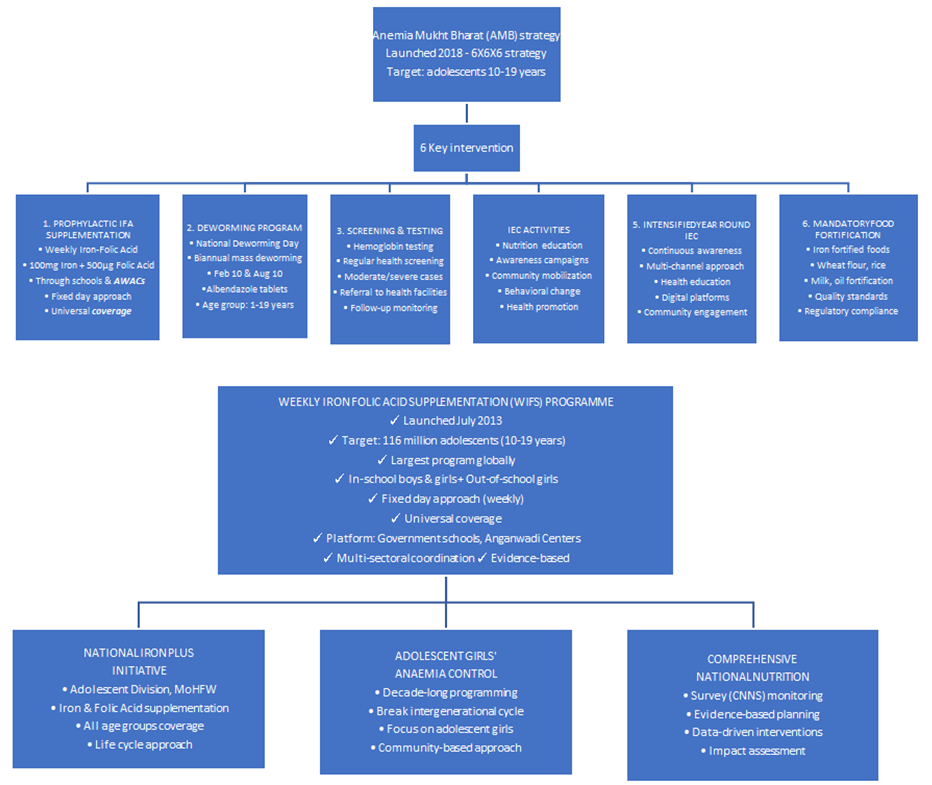
Figure 1 : National Anaemia Control Programmes and Interventions in IndiaThe high burden of anaemia despite national efforts suggests the need for addressing the social determinants described above. UNICEF stresses the importance of multi-sectoral action integrating nutrition, agriculture, sanitation, and adolescent empowerment to achieve an “Anaemia-free India” (9). Similarly, WHO calls for integrated approaches combining supplementation, fortification, infection control, and women’s empowerment. Evidence from UNICEF and national surveys confirms that progress has slowed, with minimal reduction in adolescent anaemia between 2015-16 and 2019-21 (10,16). India will not be able to achieve the nutrition targets unless these structural determinants are dealt with (12). Hence, adolescent-centred programmes are urgently needed to reduce the burden of anaemia.
The Government of India has launched several programs to address the high burden of anaemia in adolescents. Programs like the Weekly Iron and Folic Acid Supplementation (WIFS) and Anaemia Mukt Bharat (AMB) distribute regular IFA tablets, deworming and nutrition education via schools, Anganwadi centers and community health workers. These interventions ensure extensive coverage for both in-school and out-of-school adolescents. Other national initiatives, such as Poshan Abhiyan and Food fortification strategies, supplement the efforts by increasing dietary intake of iron and other micronutrients. Furthermore, the School Health and Wellness Program and Adolescent-Friendly Health Clinics focus on counselling, awareness and treatment support. Together, these multisectoral interventions not only improve hemoglobin but also equip adolescents with improved knowledge of nutrition and health practices.
Evidence indicates that these programs have been particularly effective in reducing the prevalence of anaemia and bridging social gaps, thus playing a significant role in the overall well-being and development of India’s youth.
WIFS and Anaemia Mukt Bharat have been implemented on a large scale, but their effectiveness is limited in several regions. Challenges include poor compliance due to gastrointestinal side effects of iron tablets, irregular supply chains and poor awareness among adolescents and their parents (13,14). In settings where IFA distribution takes place, research shows that adherence rates are low and many girls drop out of taking supplements early. Furthermore, there are issues like poor monitoring, deficiencies in health education, and socio-cultural barriers (15). Research in India has shown that supplementation alone cannot reduce anaemia prevalence significantly in adolescents without addressing the underlying social determinants like poverty, dietary inadequacy and gender discrimination (16,17).
Conclusion
Social inequalities strongly influence the prevalence of anaemia among adolescent females in India. Factors like poverty, lack of education,gender norms, socialmarginalisationand limited healthcare accessinteract to increase vulnerability.These factorsoperatedifferently in urban,rural and tribal settings. Reducing the burden of anaemia, therefore requires more than just iron supplementation alone.We need a multi-sectoral approach with improved nutrition from balanced diets and supplementation, better access to affordable quality healthcare and empowerment of girls through education and awareness.There is need for strengthening of the government programsso that they are delivered effectivelyat the community level.Together, these strategies can help break the cycle of inequality and improve the overall health andfuture prospectsof adolescent girls.
References/Inspiration
- Bharati P, Shome S, Chakrabarty S, Bharati S, Pal M. Burden of anaemia and its socioeconomic determinants among adolescent girls in India. Food Nutr Bull. 2009;30(3):217-226.
- Gore MN, Drozd ME, Patil RS. Anaemia prevalence and socioeconomic status among adolescent girls in rural western India: A cross-sectional study. Ethiop J Health Sci. 2024;34(1):57-64.
- Sukumar R, Raj MP, Mangla J. A study on the prevalence of anaemia among adolescent females in a tertiary care hospital in Chennai. Int J Acad Med Pharm. 2022;4(5):387-391.
- Ajgaonkar V, Shaikh N, Shyam R, Karandikar N, Patni P, Rajan S, Jayaraman A. Addressing adolescent anaemia in vulnerable urban Indian communities: A qualitative exploration. Health Educ J. 2020;79(8):950-962.
- Jha NIN, Mahida SJ, Parmar MM, Limbani TR. Prevalence and socioeconomic determinants of iron deficiency anaemia among adolescent girls in rural India. Eur J Cardiovasc Med. 2025;15(4):231-234.
- Chauhan S, Kumar P, Marbaniang SP, Srivastava S, Patel R. Prevalence and predictors of anaemia among adolescents in Bihar and Uttar Pradesh, India. Sci Rep. 2022;12:8197.
- Sedlander E, Talegawkar S, Ganjoo R, Ladwa C, DiPietro L, Aluc A, Rimal RN. How gender norms affect anaemia in select villages in rural Odisha, India: A qualitative study. Nutrition. 2021;86:111159.
- Shreya S, Kotecha PV, Vohra P, Patel SV, Mazumdar VS. Addressing supply chain challenges for anaemia prevention in adolescent girls: a qualitative study in southern India. BMC Public Health. 2024;24:150. doi:10.1186/s12889-024-17506-2.
- UNICEF India. Forging an Anaemia-Free Future [Internet]. New Delhi: UNICEF India; 2024 Sep 19 [cited 2025 Aug 14]. Available from: https://www.unicef.org/india/stories/forging-anemia-free-future
- UNICEF India. Anaemia and its determinants in 2015-16 and 2019-21: what changed for women and children? [Internet]. New Delhi: UNICEF India; 2017 Sep 15 [cited 2025 Aug 14]. Available from: https://www.unicef.org/india/stories/anemia-and-its-determinants-2015-16-2019-21-india
- Singh R, Singh U, Kumar V, Kumari R, Scott S, Yadav K. Prevalence of iron deficiency and its sociodemographic patterning in Indian children and adolescents: a subnational study from a nationally representative survey. Matern Child Nutr [Internet]. 2023 Jul 24 [cited 2025 Aug 14]. Available from: https://knowledge.unicef.org/resource/prevalence-iron-deficiency-and-its-sociodemographic-patterning-indian-children-and
- World Health Organization. Anaemia [Internet]. Geneva: WHO; 2025 [cited 2025 Aug 14]. Available from: https://www.who.int/news-room/fact-sheets/detail/anaemia
- Zou Y, Zhang RH, Xia SC, Huang LC, Fang YQ, Meng J, et al. The rural-urban difference in BMI and anaemia among children and adolescents. Int J Environ Res Public Health. 2016;13(10):1020.
- Chakrabarty M, Singh A, Singh S, Chowdhury S. Is the burden of anaemia among Indian adolescent women increasing? Evidence from Indian Demographic and Health Surveys (2015-21). PLOS Glob Public Health. 2023 Sep 6;3(9):e0002117.
- Anemia Mukt Bharat. About Anemia Mukt Bharat [Internet]. New Delhi: Ministry of Health and Family Welfare, Government of India; [cited 2026 Aug 12]. Available from: https://www.anemiamuktbharat.info/programme/about
- Scott S, Lahiri A, Sethi V, de Wagt A, Menon P, Yadav K, et al. Anaemia in Indians aged 10-19 years: Prevalence, burden, and associated factors at national and regional levels. Matern Child Nutr [Internet]. 2022 Oct; 18(4):e13391.
- Vir SC, Singh N, Nigam AK, Jain R. Weekly iron and folic acid supplementation with counseling reduces anemia in adolescent girls: a large-scale effectiveness study in Uttar Pradesh, India. Food Nutr Bull. 2008 Sep;29(3):186-94.
- Kapil U, Bhadoria AS. National Iron-plus Initiative guidelines for control of iron deficiency anaemia in India, 2013. Natl Med J India. 2014;27(1):27-9.
- Ministry of Health and Family Welfare. Anemia Mukt Bharat: Intensified National Iron Plus Initiative (I-NIPI) Operational Guidelines for Program Managers. New Delhi: Government of India; 2018.
- Pasricha SR, Tye-Din J, Muckenthaler MU, Swinkels DW. Iron deficiency. Lancet. 2021 Jan 9;397(10270):233-48.
- Toteja GS, Singh P, Dhillon BS, Saxena BN. Prevalence of anemia among pregnant women and adolescent girls in 16 districts of India. Food Nutr Bull. 2006 Dec;27(4):311-5.

No comments yet.